

HIS WORKS
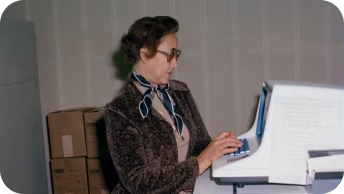
Katherine Johnson performing calculations at NASA
What achievements and advancements are owed to this engineer?
Published on October 20, 2025
By the editorial team of TrajectoireK.fr
A brilliant mathematician at NASA, Katherine Johnson revolutionized space exploration with her exceptionally precise calculations. From the Mercury mission to Apollo 11, her work enabled humanity to cross a new frontier: that of space.
The Mercury-Redstone 3 mission
In 1961, the United States sent a human into space for the first time. This historic feat was accomplished by astronaut Alan Shepard, whose name has remained famous. However, another person also deserves recognition: Katherine Johnson. Joining NACA in 1953, the organization that would later become NASA, she worked at the Langley research center. Her role was essential, as she accurately calculated the trajectory of the Mercury-Redstone 3 flight, thus ensuring the success of this mission.
Click to start the video
A reference text
In 1960, Katherine Johnson wrote a scientific report on the trajectory and recovery of satellites. This technical document, titled Technical Note D-233, consists of 36 pages and is co-authored with engineer Ted Skopinski. It explains, using equations, the various stages of an orbital flight, particularly how to determine the ideal position for the spacecraft to return to Earth with precision. This work later served as a valuable foundation for the historic space missions of Alan Shepard in 1961 and John Glenn in 1962.
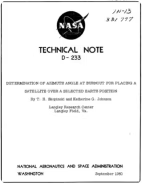
The technical note D-233 by Katherine Johnson and Ted Skopinski
The Mercury-Atlas 6 mission
In 1962, Katherine Johnson played a crucial role in the Mercury-Atlas 6 mission, the first to send an American, John Glenn, into orbit around the Earth. Tasked with verifying the trajectory calculations made by computer, she recalculated them by hand at the astronaut's request, who trusted only her expertise. After a day and a half of checks, her results confirmed those of the machines, allowing the successful flight of the Friendship 7 capsule.
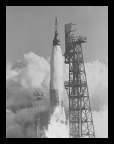
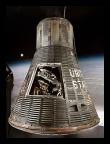
Components of the Mercury-Atlas 6 mission
The Apollo 11 mission
More than 50 years ago, in 1969, Katherine Johnson helped NASA succeed in the Apollo 11 mission, which sent the first humans to walk on the Moon. She performed the essential calculations to synchronize the lunar module, which landed on the Moon, with the Apollo command module, the spacecraft that carried the astronauts. These calculations allowed the astronauts to land accurately and return safely to Earth. Katherine Johnson's work was crucial to the success of this great space adventure.
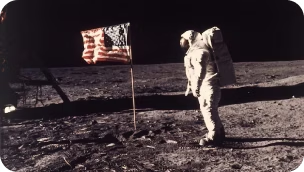
Americans on the Moon: Apollo 11 mission
Katherine Johnson retired in 1986. She wrote 26 research reports during her career. In 2015, the scientist received the Presidential Medal of Freedom, the highest civilian honor in the United States.
Learn more about Katherine Johnson